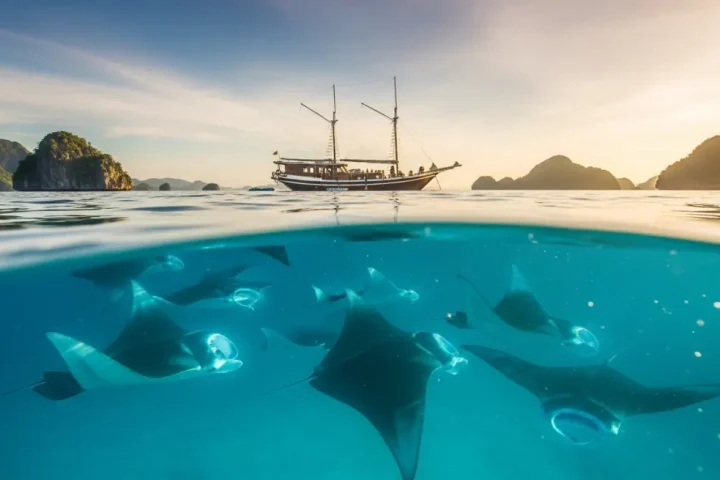
Mantas are effectively year-round in Raja Ampat, with the most reliable encounters inside the October–April sailing season. Reef sharks and turtles are constant. Whale sharks are a different destination question entirely — Triton Bay and Cenderawasih, not central Raja Ampat. Birds of paradise display at dawn most of the year. No operator can guarantee any of it.
Wildlife calendars are the most over-promised content in dive marketing. The honest position for Raja Ampat is that it is unusually consistent — this is not a destination where the animals disappear for six months — but that consistency gets oversold into guarantees that nobody can honour. Here is what actually varies.
What can you expect month by month?
| Month | Mantas | Reef sharks / turtles | Conditions | Notes |
|---|---|---|---|---|
| October | Good | Constant | Settling, generally calm | Season opens; boats reposition into the region |
| November | Good | Constant | Calm | Fewer boats, good value |
| December | Very good | Constant | Mostly calm, occasional squalls | Peak demand begins; plankton pulses possible |
| January | Very good | Constant | Calm with squalls | Strong feeding activity in plankton-rich weeks |
| February | Very good | Constant | Best overall window | Heart of the season |
| March | Very good | Constant | Calm | Excellent conditions, peak still busy |
| April | Good | Constant | Calm, season closing | Value improves, boats begin repositioning |
| May – September | Present | Constant | Windier, more swell | Most vessels operate elsewhere; limited sailing availability |
Notice what the table does not say: it does not identify a single “best month” for wildlife. The variation across the season is smaller than the variation between individual weeks, and week-to-week conditions are driven by tides and plankton rather than the calendar.
Why do plankton months matter more than the month itself?
Because plankton is the mechanism. When nutrient-rich water pushes through the straits, visibility drops from thirty metres to fifteen and photographers groan — and mantas arrive to feed. Barrel-rolling, chain-feeding, surface skimming: the behaviours people travel across the world for happen in exactly the water conditions that look disappointing from the deck.
If your priority is wide-angle reefscapes in blue water, you want the clearer weeks. If your priority is animal behaviour, you want the murkier ones. You cannot book either in advance — which is why we are sceptical of any calendar that claims to. Our guide to water temperature, visibility and currents explains the mechanism in more detail.
Where are the whale sharks, actually?
Not in central Raja Ampat, in any reliable sense. The well-known Indonesian whale shark encounters happen at bagan — floating fishing platforms — in Cenderawasih Bay and around Triton Bay, where the animals associate with the platforms and feed on small fish spilled from the nets.
Both are separate destinations reached on longer expedition itineraries or crossings, typically ten to fourteen nights and often scheduled in repositioning windows when vessels move between regions. Our Triton Bay expedition and Banda Sea crossing pages set out how those work and when they run.
If a Raja Ampat itinerary promises whale sharks on a seven-night central route, treat the whole brochure with suspicion.
When do birds of paradise display?
Most of the year, at dawn, and this is one of Raja Ampat’s genuinely underrated experiences. The red bird of paradise displays in the forest canopy above villages including Sawinggrai on Gam, and Wilson’s bird of paradise is found in the same broad area. Display activity is generally reported as strongest in the drier months, but morning displays occur across much of the year.
Practicalities matter more than seasonality here:
- Dawn means dawn. A pre-05:00 tender ride, then a walk uphill in the dark to a viewing spot before first light.
- The trek is short but steep and slippery. Proper shoes, not dive booties.
- It is a listening experience as much as a visual one. Bring binoculars; the birds are high in the canopy and a long lens without a tripod rarely delivers.
- Silence is required. Groups that chatter see nothing.
- Local guides only. The village manages access, and a guide fee is part of the arrangement.
Our guide to Arborek and Sawinggrai village visits covers the etiquette and what the fees pay for.
What else is seasonal — and what is not?
Not seasonal: reef sharks, wobbegongs, turtles, the astonishing reef fish density that made Cape Kri famous, soft coral, nudibranchs. These are simply present, all season, everywhere.
Somewhat seasonal: manta feeding intensity (tracks plankton), pygmy seahorse sightings (guide-dependent more than season-dependent), coral spawning events (typically tied to lunar cycles rather than months, and genuinely difficult to plan around).
Genuinely different destinations: whale sharks at bagan platforms, hammerheads, and the Banda Sea’s sea snakes and volcanic topography. Do not book a central Raja Ampat trip expecting these.
Turtle nesting occurs on beaches across the region, but nesting is nocturnal, sensitive and not something responsible operators build a schedule around. If a nesting encounter happens, it will be because a crew member noticed and asked you to keep your distance and your torch off.
How should you pick your month?
Work backwards from one priority rather than trying to optimise everything:
| If your priority is… | Aim for | Accept |
|---|---|---|
| Manta feeding behaviour | Dec – Mar, plankton-rich weeks | Lower visibility |
| Clear water wide-angle | Oct – Nov, Mar – Apr | Slightly less feeding activity |
| Fewest boats | Oct – Nov, Apr | Season edges, some weather variability |
| Best overall conditions | Feb – Mar | Peak pricing and early booking |
| Whale sharks | Triton Bay or Cenderawasih expedition | 10 – 14 nights, different itinerary |
| Birds of paradise | Any month with a dawn village stop | An early start and a steep walk |
Then book early — peak weeks go nine to fifteen months out, as covered in our 2027 booking guide. The Wayag charter is the northern option for landscape-led trips.
Frequently asked questions
When is manta season in Raja Ampat?
Mantas are present year-round, with the most reliable encounters inside the October–April sailing season and particularly December to March. Feeding activity tracks plankton rather than the calendar.
Can you see whale sharks in Raja Ampat?
Not reliably in central Raja Ampat. The known Indonesian encounters are at fishing platforms in Cenderawasih Bay and around Triton Bay, reached on longer expedition itineraries.
What is the best month to visit Raja Ampat for wildlife?
February and March offer the best overall combination of conditions and activity, but week-to-week variation matters more than the specific month.
When can you see birds of paradise in Raja Ampat?
Dawn displays occur across much of the year, with village-guided treks from places like Sawinggrai on Gam. It requires a pre-dawn start and a short steep walk.
Are wildlife sightings guaranteed in Raja Ampat?
No. Encounter rates at established sites are high in peak months, but no operator can guarantee wild animals, and anyone who does is making a promise they cannot keep.
Does low visibility mean fewer animals?
Usually the opposite. Plankton-rich water reduces visibility and increases feeding activity, which is when manta behaviour is at its most spectacular.
Are there sharks in Raja Ampat?
Yes, routinely. Grey and blacktip reef sharks are common on the main sites and wobbegongs rest under ledges. The region has long operated as a shark and manta sanctuary area.
When is turtle nesting season in Raja Ampat?
Nesting occurs on regional beaches but is nocturnal and sensitive. Responsible operators do not schedule around it, and any encounter should be observed from a distance with torches off.
Match the month to what you came for
Tell us the one animal or condition that matters most and we will point you at the weeks that realistically deliver it — and tell you plainly when what you want needs a different itinerary altogether. Trips are operated by Komodo Luxury, an Indonesian charter operator since 2015.
WhatsApp: +62 811 3823 875 · Email: [email protected]