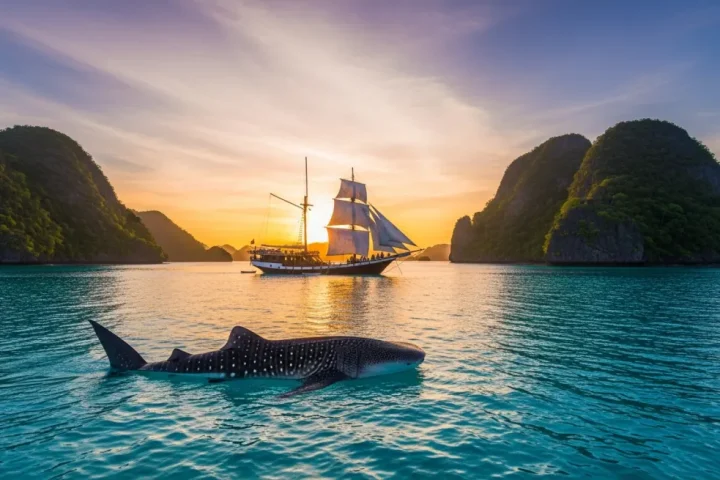
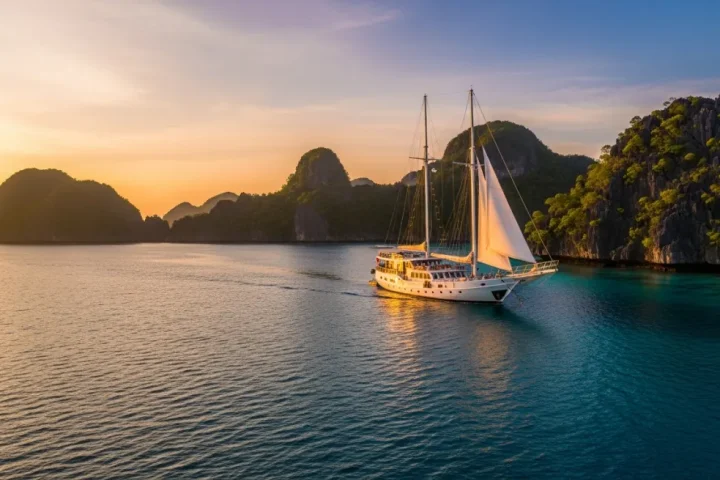
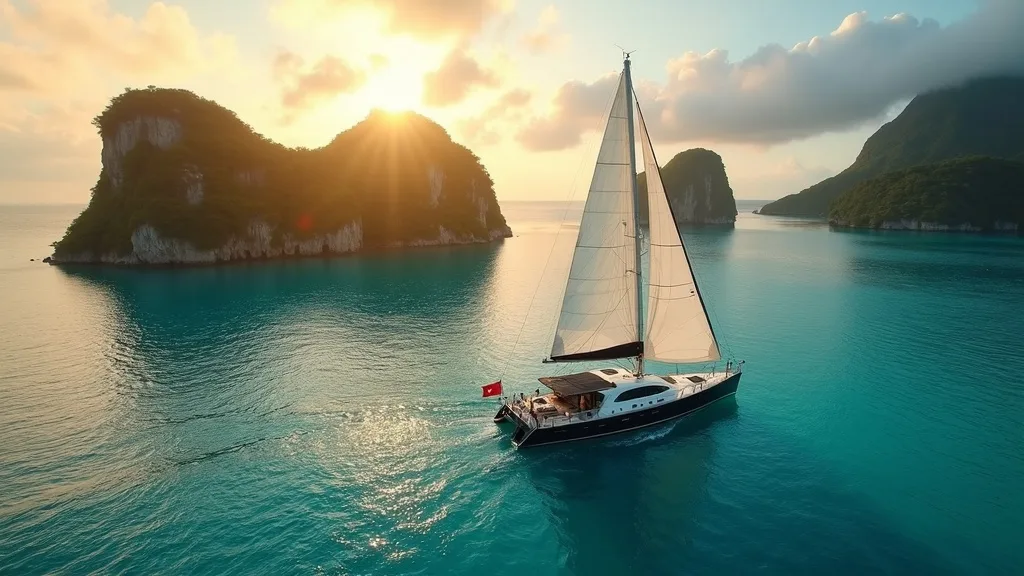
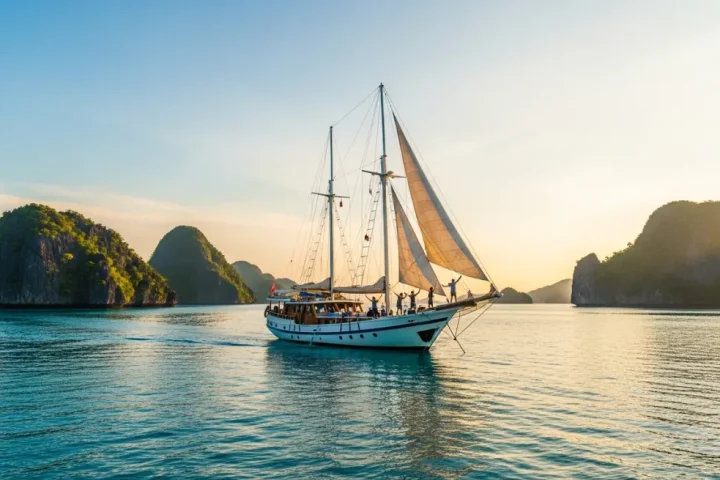
A Raja Ampat to Banda Sea crossing runs ten to fourteen nights and is scheduled only in the shoulder or repositioning windows, when vessels move between cruising grounds. This is an expedition rather than a holiday cruise: long open-water passages, remote volcanic islands, and diving that rewards experience rather than beginners. Indicative pricing sits in the USD 250–700 per person per night range depending on vessel tier, with whole-boat charter from roughly USD 4,500 per night. Departures are few and sell a year ahead.
Every year, between seasons, the Indonesian liveaboard fleet migrates. Boats that spend December to March in Raja Ampat need to reach Komodo, Ambon or Maumere, and the sensible route runs south through the Banda Sea. Rather than sail empty, the good operators sell those legs as expeditions — and they are, by some distance, the most interesting trips in the Indonesian calendar. You are not visiting a destination; you are crossing an ocean basin that happens to have islands in it.
What does the route cover?
| Leg | Typical nights | What it involves |
|---|---|---|
| Raja Ampat leg | 2 – 4 | Dampier Strait and Misool sites before turning south — Cape Kri, Magic Mountain, Boo Windows depending on direction of travel |
| Open-sea passage | 1 – 2 full days | Continuous passage across deep water; the boat runs day and night, cetacean watch from the top deck |
| Banda Islands | 3 – 5 | Volcanic walls and lava flows, the historic nutmeg town of Banda Neira, Gunung Api |
| Optional Triton Bay extension | 2 – 3 | Soft-coral density and whale sharks around Kaimana’s fishing platforms — see the Triton Bay expedition |
| Disembarkation transit | 1 – 2 | Passage to the exit port, usually Ambon or back to Sorong depending on direction |
Directionality matters more than most operators explain. Northbound and southbound crossings are different trips: the same islands in a different order, with the long passage falling at a different point in the week and a different arrival airport. Ask which direction a departure runs before you book flights.
When do crossings actually happen?
The Raja Ampat sailing season runs roughly October to April, and most vessels reposition out of the region during the mid-year months. Crossings therefore cluster at the season boundaries — the weeks when boats are moving in or moving out. That has three practical consequences:
- Very few departures. A given vessel typically runs one or two crossings a year, sometimes none. Across the whole fleet there might be a couple of dozen suitable departures in a season.
- Long booking lead times. Twelve months is normal for the good boats, and crossings frequently sell out before the standard Raja Ampat itineraries around them.
- Fixed dates. You cannot move a repositioning leg — the boat has to be somewhere on a particular day for the next charter. Your flights fit the crossing, not the reverse.
If your dates are fixed and a crossing does not align, the honest alternative is the 11-night Raja Ampat expedition, which delivers comparable length inside a single region. The wider route logic sits on our sailing routes page, and we have written separately about November crossing departures.
What are the passages really like?
We would rather set expectations honestly than have guests discover this at sea. A crossing includes at least one continuous passage of twenty-four to thirty-six hours with no anchorage, no dive, and nothing to do but watch water. On a settled day that is glorious — flying fish, pilot whales, dolphins riding the bow wave, the sort of sky you only get two hundred miles from a city. On a rough one, it is a long time to be horizontal in a cabin.
What you should know: the boat runs a watch routine day and night, so there is engine noise and movement through the small hours; meals continue on schedule but appetite may not; and motion-sickness medication works far better taken before the passage than after. Guests who are strongly motion-sensitive should think hard about whether a crossing is the right trip — the Raja Ampat-only itineraries have almost no exposed passages by comparison.
What do crossings cost?
| Option | USD per person per night | 10-night total | 14-night total |
|---|---|---|---|
| Mid-range dive liveaboard, twin | 250 – 400 | 2,500 – 4,000 | 3,500 – 5,600 |
| Boutique sailing yacht, deluxe | 600 – 700 | 6,000 – 7,000 | 8,400 – 9,800 |
| Luxury Phinisi, master suite | 1,200 – 2,400 | 12,000 – 24,000 | 16,800 – 33,600 |
| Whole-vessel charter | from ~4,500 per night; 8,000 – 12,000+ flagship | from ~45,000 | from ~63,000 |
Fees are separate. Raja Ampat charges a marine park entry permit of IDR 700,000 per foreign visitor (IDR 425,000 Indonesian, twelve months, multi-entry) plus a regency visitor entry ticket of IDR 1,000,000 (IDR 300,000 Indonesian) — roughly IDR 1,700,000 for a foreign guest, as of July 2026 and confirmed at booking. Banda has its own smaller local charges, usually handled by the vessel. Note that Raja Ampat is a regionally managed marine protected area network, not a national park.
Who should book a crossing?
Right for: experienced divers with a hundred-plus logged dives who want walls, pelagics and sea snakes rather than reef gardens; underwater photographers who have already covered Raja Ampat; repeat Indonesia travellers looking for the next thing; people who genuinely enjoy being at sea.
Wrong for: first-time liveaboard guests; anyone who gets seasick; snorkel-led groups (Banda’s diving is deep-wall work with far less shallow reef than Raja Ampat); families with young children; and anyone whose leave is tight enough that a weather delay would cost them a connecting flight.
What are the logistics?
The key question on any crossing is which port you fly into and which you fly out of — they are rarely the same. Raja Ampat departures and arrivals use Sorong (SOQ); note that “DEO”, which you will see locally, is the airport’s name abbreviation rather than its IATA code. Banda-end trips typically embark or disembark in Ambon, which connects through Jakarta, Makassar or Manado. Approximate flight times to Sorong: Jakarta (CGK) four to four and a half hours, Makassar (UPG) about two hours, Manado (MDC) one and a half to two hours.
Book flexible or refundable domestic tickets on both ends. Crossings are the one product where weather genuinely moves arrival times, and a non-refundable same-day international connection is a bad bet. Build a buffer night into each end of the trip.
Frequently asked questions
How long is the longest passage?
Typically twenty-four to thirty-six hours of continuous open-water sailing between the Raja Ampat and Banda groups, with no diving during that window.
Will we see hammerheads?
The Banda Sea has a reputation for pelagic encounters and hammerheads are among them, but nobody can promise them. Treat any operator guaranteeing a species as a warning sign.
Can non-divers join a crossing?
They can, but we generally advise against it. Banda’s diving is deep-wall and pelagic-focused with far less shallow reef than Raja Ampat, and a non-diver faces long stretches with little to do. A snorkel-led Raja Ampat trip is a much better use of the same money.
How experienced do divers need to be?
Advanced certification with substantial current and deep-water experience. Many vessels set a minimum logged-dive count for crossings specifically.
Are there sea snakes at Manuk?
Manuk and Gunung Api are known for high sea-snake densities and appear on many Banda itineraries, though inclusion depends on the vessel’s route and sea state. Confirm against the specific departure rather than assuming.
Can we charter a crossing privately?
Yes, and for dive clubs of ten to sixteen it is often the cleanest way to secure the dates. Whole-vessel rates start around USD 4,500 per night — see private Phinisi charter.
What happens if weather delays the crossing?
The captain adjusts the route or the schedule, and the itinerary is treated as indicative throughout. No refund is customary for weather routing anywhere in this market — which is exactly why buffer days matter.
Is Triton Bay always included?
No. It is an extension on some crossings and absent from others. If Triton Bay is your reason for travelling, book a departure that names it explicitly rather than hoping for it.
Enquire about crossing departures
Crossing dates are few and fixed. Tell us your season and we will tell you which vessels are actually repositioning through the Banda Sea in that window, in which direction, and what remains. Reservations are handled by Komodo Luxury, our parent operator since 2015, part of Juara Holding Group.
WhatsApp: +62 811 3823 875 · Email: [email protected]