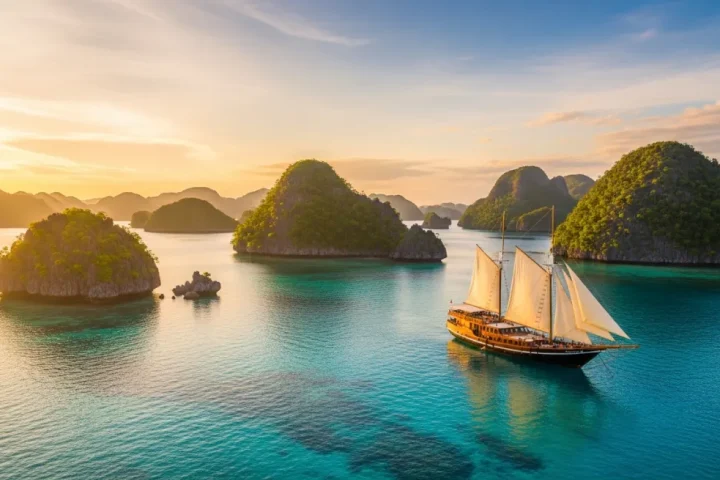
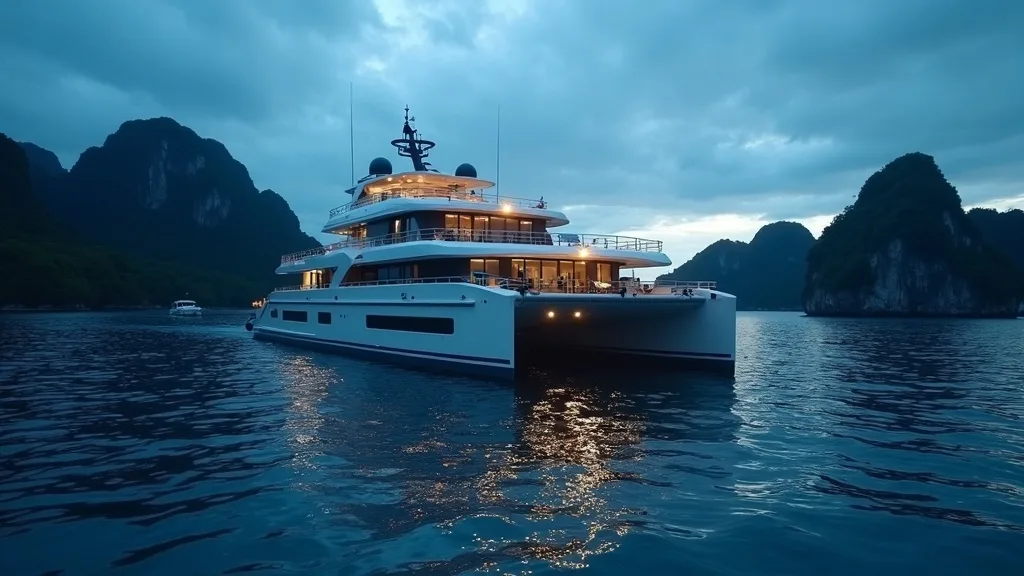
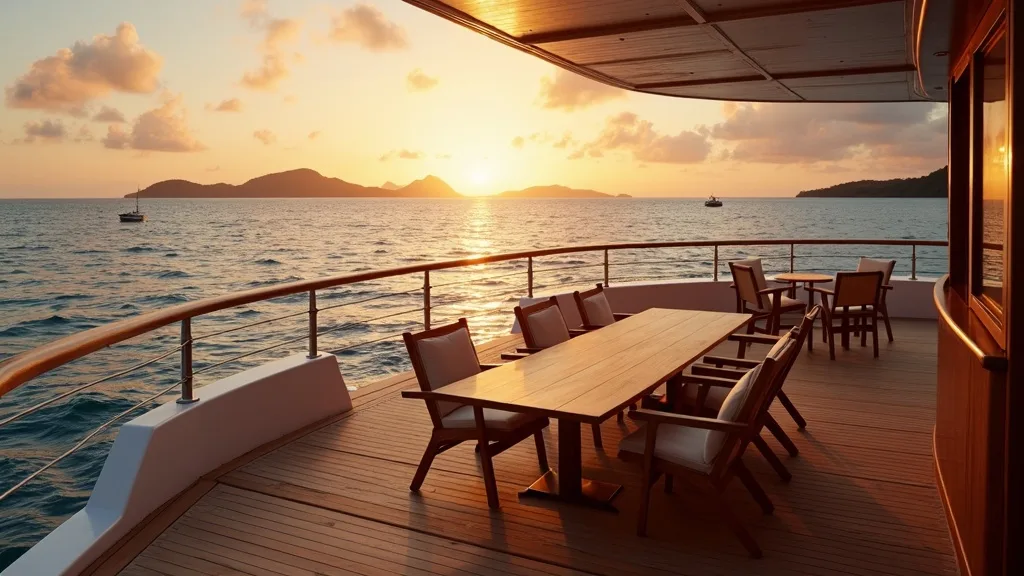
Yes — Raja Ampat is genuinely world-class for snorkellers, not a consolation prize. Most of its signature reefs top out between three and eight metres, which means the coral density, the colour and the fish are all in the first few metres of water. A snorkel-led sailing trip reorders the itinerary around shallow, low-current sites: Melissa’s Garden, Arborek and Yenbuba jetties, Friwen Wall, Kabui’s mangroves and the Wayag lagoon. Typical trips run five to seven nights from Sorong (SOQ), often at a lower fare than the diver rate on the same vessel.
The standard assumption is that Raja Ampat is a diver’s destination and everyone else tags along. That assumption is wrong, and it comes from itineraries designed around dive schedules rather than around reefs. Reorder the week — put the shallow sites at the centre and the current sites at the edge — and non-divers get a trip that is not a compromise at all.
Which sites are best for snorkellers?
| Site | Depth of the good stuff | Current | Difficulty | What you see |
|---|---|---|---|---|
| Melissa’s Garden (Fam) | 3 – 10 m | Mild | Easy | One of the densest hard-coral plateaus in Raja Ampat; staghorn and table coral to the horizon |
| Arborek jetty | 2 – 8 m | Mild | Easy | Pilings coated in soft coral, glassfish clouds, sweetlips; village above |
| Yenbuba jetty | 2 – 10 m | Mild to moderate | Easy | Coral gardens, schooling batfish, exceptional light for photography |
| Friwen Wall | 3 – 12 m | Mild | Easy | Soft-coral wall in sheltered water; the friendliest good site in the archipelago |
| Mioskon | 4 – 12 m | Mild to moderate | Easy to moderate | Wobbegong sharks resting under plate coral, bumphead parrotfish, fruit bats in the trees |
| Manta Sandy (surface) | 12 – 18 m below you | Mild | Moderate | Reef mantas circling the cleaning station, watched from the surface |
| Kabui Bay mangroves | 1 – 5 m | Tidal | Easy | Mangrove roots dropping into clear water, juvenile fish, archerfish, extraordinary light |
| Wayag lagoon (9N+ routes) | 2 – 8 m | Mild | Easy | Shallow fringing reef beneath karst towers; sandbank swimming |
Note what is missing: Blue Magic, Sardine Reef and Cape Kri. Those are high-current pelagic sites and they are not snorkelling propositions. Any operator putting a float vest into a two-knot drift at Cape Kri is being careless. On our snorkel-led trips those sites are dived by the divers while the snorkel group works a sheltered alternative — usually a better use of everyone’s morning.
How is a mixed dive and snorkel day actually run?
The tender runs divers to the drop first, then comes back for the snorkel group with a dedicated in-water guide. That guide is the whole difference between a good snorkel trip and a mediocre one: they pick the entry point for the tide, keep the group over the shallowest coral, tow a float for anyone tiring, and know which pilings hold the glassfish that morning. On the vessels we work with, the snorkel guide is a permanent crew member, not a dive guide borrowed on quiet days.
Two smaller things matter more than they sound. First, tender pickup: snorkellers should never be asked to swim back to a boat against current, and a well-run trip keeps the tender drifting with the group. Second, timing — the shallow sites are best in the middle of the day when the sun is directly overhead and the coral colour is fully lit, which is precisely when divers are on their surface interval. A snorkel-led schedule takes advantage of that instead of fighting it.
What do the snorkel-led schedules look like?
| Day | 5-night snorkel route | 7-night snorkel route | Sailing hours |
|---|---|---|---|
| 1 | Board Sorong (SOQ), Friwen Wall | Board Sorong (SOQ), Friwen Wall | 4 – 6 |
| 2 | Yenbuba, Mioskon, Kri shallows | Yenbuba, Mioskon, Kri shallows | 1 – 2 |
| 3 | Arborek jetty and village, Manta Sandy from the surface | Arborek jetty and village, Manta Sandy from the surface | 1 – 3 |
| 4 | Overnight to Fam; Melissa’s Garden, Piaynemo viewpoint at dawn | Overnight to Fam; Melissa’s Garden, Piaynemo at dawn, Penemu lagoon | 3 – 5 |
| 5 | Kabui Bay mangroves, Telaga Bintang, return leg | Kabui Bay mangroves, Telaga Bintang | 3 – 5 |
| 6 | Disembark Sorong | Second Fam morning or return to Arborek | 2 – 4 |
| 7 – 8 | — | Final shallow site, overnight leg, disembark Sorong | 4 – 6 |
What gear and safety arrangements are provided?
Mask, snorkel and fins are standard on every vessel; bring your own mask if you have one that fits, because a leaking rental ruins a week. Beyond that, ask specifically about: float vests or noodles for weaker swimmers, a towed surface float on every guided snorkel, rash guards or 3 mm shorties (the water is warm at roughly 27–30 °C, but four hours a day in it still chills you), and reef-safe sunscreen or, better, a long-sleeved rash guard instead of sunscreen.
On current: even the easy sites move. The rule we brief is simple — always enter up-current of where you want to end, always stay with the guide’s float, and never try to swim against a drift. Weak swimmers are not excluded from any site on this list, but they should be honest at booking so the crew can plan for a float and a closer tender.
What does a snorkel-led trip cost?
| Vessel tier | Diver rate, USD pp/night | Snorkeller rate, USD pp/night | Why the gap |
|---|---|---|---|
| Mid-range liveaboard | 250 – 400 | roughly 15 – 25% lower | No tanks, weights, air fills or dive-guide ratio |
| Boutique sailing yacht | 600 – 700 | roughly 10 – 20% lower | Same cabin and food; diving is the variable cost |
| Luxury Phinisi | 1,200 – 2,400 | often the same | All-inclusive pricing rarely separates the two |
The discount is real but modest, and any operator quoting a snorkeller rate at half the diver fare is either padding the diver price or cutting the snorkel programme. Government fees are identical for everyone: marine park entry permit IDR 700,000 for foreign nationals (IDR 425,000 Indonesian, valid twelve months, multi-entry) plus the regency visitor entry ticket at IDR 1,000,000 (IDR 300,000 Indonesian) — around IDR 1,700,000 total for a foreign guest, as of July 2026 and confirmed at booking. Compare fares on our charter cost page.
Does it work for children and older travellers?
What works. Children who can swim confidently do extremely well here — the jetty sites at Arborek and Yenbuba are shallow, calm and endlessly interesting, and the village visits give them something ashore. Older travellers who snorkel comfortably get the whole trip; the Piaynemo viewpoint has a built staircase with handrails rather than a scramble.
What does not. Non-swimmers of any age will find the good sites frustrating, and no amount of flotation changes that. Guests with limited mobility should know that tender transfers involve stepping between moving boats several times a day. And the Wayag and Telaga Bintang viewpoints are genuine scrambles over sharp limestone — both are optional, and both are worth skipping if knees are a question. Our sailing holiday planner and the sailing Raja Ampat with family guide go into more detail.
Frequently asked questions
Will I really see as much as the divers?
At Melissa’s Garden, Arborek, Yenbuba and Friwen Wall, arguably more — the coral density sits in the top ten metres and holds its colour without a torch. At Cape Kri, Blue Magic and the Misool pinnacles, no. Roughly two-thirds of Raja Ampat’s greatest hits are snorkellable.
Can I see manta rays while snorkelling?
Yes, from the surface at Manta Sandy, where reef mantas circle a cleaning station in twelve to eighteen metres. You watch from above rather than kneel behind the viewing line. Sightings are frequent in season but never guaranteed.
How cold does the water get?
It does not, really — typically 27–30 °C year-round. The issue is duration, not temperature. Four hours a day in warm water still leaves you chilled, so a rash guard or shortie is worth packing.
What is the visibility like?
Commonly 15 to 30 metres or more, lower around mangroves and in plankton-rich water. From the surface at shallow sites you are looking through very little water anyway, so viz matters less to snorkellers than to divers.
Do I need to be a strong swimmer?
You need to be a comfortable one. Guided snorkels use a towed float, tenders stay close and vests are available, but the currents are real. Tell us your comfort level honestly at booking.
Is Wayag worth it for snorkellers?
The lagoon and sandbank swimming are lovely and the landscape is unmatched, but northern routes need nine nights or more. If your priority is reef time rather than scenery, a shorter Dampier Strait trip gives you more water per day.
Can I learn to dive during the trip?
On some vessels, yes — an Open Water course or a Discover Scuba session can often be arranged. It has to be booked in advance so an instructor and materials are aboard. Raja Ampat’s currents make it a demanding place to learn, and we will say so.
What is the best itinerary length for snorkellers?
Five to seven nights. Snorkelling days are less structured than dive days and the shallow sites cluster centrally, so the extra nights that divers spend chasing remote pinnacles add less for you.
Can we combine with a shorter package?
Yes — the 5D4N package works well as a snorkel-led trip, and the Fam and Piaynemo leg is where the best snorkelling in the archipelago sits.
Should we charter privately as a snorkelling group?
If there are eight or more of you and nobody dives, yes. A charter lets the whole schedule run on snorkel timing — midday light, longer water sessions, no waiting on dive rotations. Whole-vessel charter starts around USD 4,500 per night.
Plan a snorkel-led Raja Ampat voyage
Tell us how many of you there are, who dives and who does not, and how confident the swimmers are. We will match you to a vessel with a real snorkel guide rather than one that treats non-divers as passengers. Reservations are handled by Komodo Luxury, our parent operator since 2015, part of Juara Holding Group.
WhatsApp: +62 811 3823 875 · Email: [email protected]