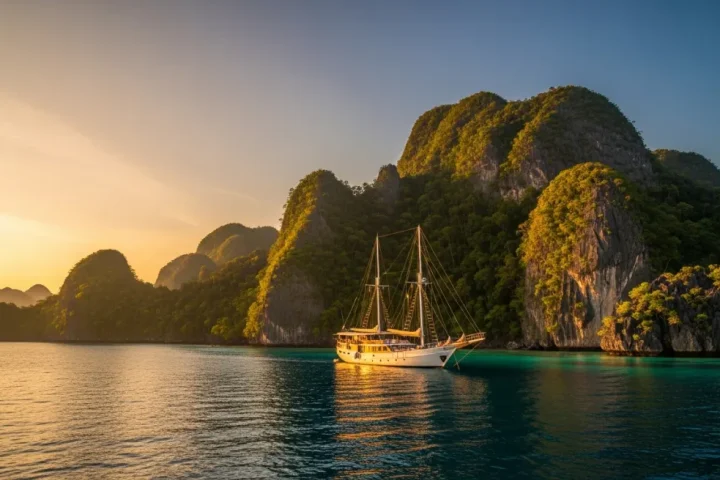
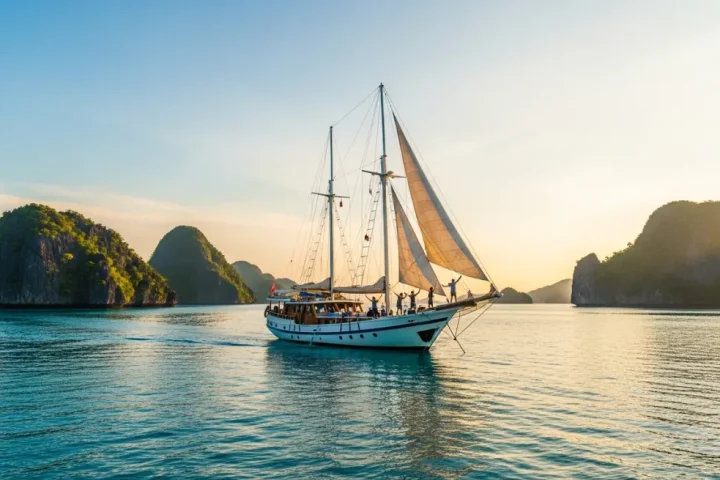
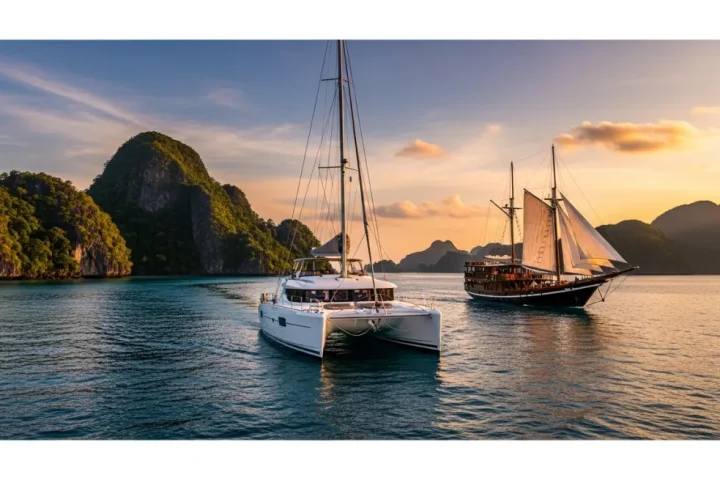
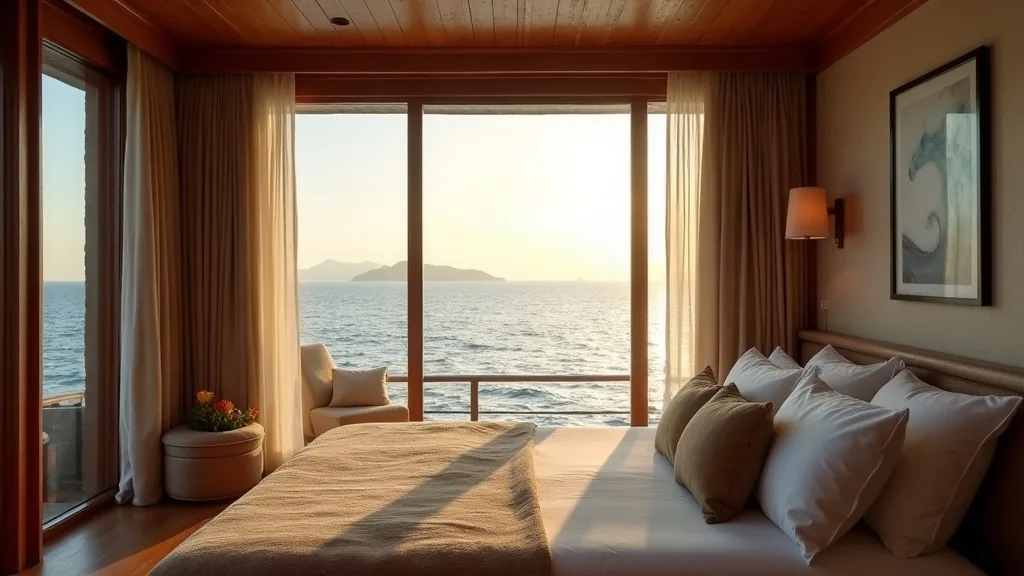
Homestays are the cheapest way to see Raja Ampat, resorts are the most comfortable way to stay in one place, and a sailing yacht is the only realistic way to reach Wayag and Misool. The choice is not really about budget — it is about geography. Land-based options access a limited radius of sites; a boat moves the accommodation to the diving.
This comparison gets written badly a lot, usually by whoever sells one of the three. So here is the honest version, including the parts that argue against booking a boat.
How do the three options compare?
| Homestay | Resort | Sailing yacht / liveaboard | |
|---|---|---|---|
| Typical nightly cost per person | Low — usually well under USD 100 with meals | Mid to high, varies enormously | USD 250 – 400 mid-range; 600 – 700 boutique; 1,200 – 2,400 luxury |
| Sites reachable | Local reefs plus day trips within reach of a small boat | House reef plus organised day trips | Entire cruising ground; Wayag and Misool on longer trips |
| Comfort | Basic — simple room, often shared or bucket bathroom | High | High, but a moving vessel |
| Food | Simple local meals, usually included | Restaurant standard | Full board, cooked to order for the group |
| Dives per day | 1 – 2, weather dependent | 2 – 3 | 3 – 4 plus night dives |
| Money reaching local communities | Highest — direct to families | Variable | Via fees, village visits and local crew employment |
| Best for | Budget travellers, long stays, cultural immersion | Non-divers, families, honeymoons on land | Divers, photographers, anyone wanting the full archipelago |
Nightly figures are market bands rather than quotes, and the boat range is wide because it spans everything from a functional dive vessel to a flagship Phinisi. Our cabin types guide explains why the same trip on the same boat can differ by a factor of two.
Where do homestays genuinely win?
More often than the diving industry likes to admit.
Homestays are locally owned, usually by a single family, and the money goes straight into the village economy. You sleep in a simple wooden bungalow, frequently over the water, eat rice and fish with the family, and fall asleep to a sound environment that no boat generator can compete with. For travellers who want to be in Raja Ampat rather than passing through it, nothing else comes close.
They also win on time. Two weeks in a homestay costs less than a week on a mid-range liveaboard, and if your priority is a long, slow trip rather than maximum site coverage, that arithmetic is decisive.
What you accept in return: basic facilities, sometimes bucket showers and no reliable electricity; boat trips that depend on weather and on enough guests to share the fuel; limited or no dive infrastructure at many homestays, meaning you dive with a separate operator; and a much smaller radius of accessible sites.
Where does a resort make most sense?
For travellers who want comfort in one place, and particularly for mixed groups where not everyone dives. A resort gives you a proper room, consistent food, a house reef you can enter whenever you like, and no requirement to sleep on a moving vessel — which matters more than people expect if anyone in the party is prone to seasickness.
Resorts also work well for families with young children, where cabin life and dive-deck logistics become complicated, and for non-diving partners who would rather have a beach and a hammock than four dives a day.
The trade-off is radius. A resort’s day trips reach a fixed set of sites; the famous northern and southern regions remain out of reach, and repeat visits to the same house reef will not satisfy a photographer.
Where is a boat genuinely the only option?
Three places, and they are the ones people cross the world for:
- Wayag. The karst labyrinth in the far north with the famous viewpoint hike, lagoons and sandbanks. It is a long way from any land-based accommodation and is normally reached on nine-night or longer sailing routes, with itineraries treated as weather-dependent.
- Misool. The soft-coral pinnacles and limestone arches in the south — Magic Mountain, Boo Windows, Four Kings. Reaching them properly means an overnight passage each way and a nine- to twelve-night trip. Our Misool dive site guide explains why.
- Multiple sites in one day at the right tide. This is the underrated one. A boat can dive Blue Magic at slack, move to Manta Sandy, then finish at a shallow reef — because the accommodation moves with you.
If none of those matter to you, a boat may genuinely be the wrong purchase. We would rather say that than sell you a week you did not need.
Can you combine them?
Yes, and it is often the best-value structure for a first trip. A common shape:
- Fly into Sorong, take the ferry to Waisai (about two hours; published fares IDR 250,000 VIP and IDR 125,000 economy).
- Three to five nights in a homestay around Waigeo or Gam — slow days, village life, snorkelling, a bird of paradise trek at dawn.
- Return to Sorong and board a four- or five-night sailing trip covering the Dampier Strait and Fam.
You get the cultural depth of a homestay and the site access of a boat, and the marine park permit covers both since it is valid twelve months with multiple entries. Our 5D4N sailing package exists partly for exactly this pattern, and the snorkelling trip suits mixed-ability groups coming off a land stay.
What are the hidden costs in each model?
| Model | Costs people forget |
|---|---|
| Homestay | Boat transfers charged per trip and often per person; separate dive operator fees; ferry tickets; fuel surcharges on longer day trips |
| Resort | Dive packages priced separately; transfer boat from Sorong or Waisai; drinks; equipment rental |
| Liveaboard | Government fees (around IDR 1,700,000 for foreigners, as of July 2026); crew gratuities; nitrox; equipment rental; alcohol |
| All three | Domestic flight baggage excess for dive gear; a buffer night in Sorong; travel insurance with evacuation cover |
Ask any operator for a written cost sheet with fees listed separately. A quote that bundles everything into one number is not more convenient — it is less checkable.
Frequently asked questions
What is the cheapest way to visit Raja Ampat?
A homestay, by a wide margin, particularly on a longer stay. You trade comfort and site access for cost and cultural immersion.
Can you see Wayag or Misool without a liveaboard?
Realistically no. Both are far from land-based accommodation and are normally reached on nine-night or longer sailing itineraries.
Are Raja Ampat homestays comfortable?
They are simple: wooden bungalows, often over water, with basic bathrooms and limited electricity. Comfortable in the sense that matters to some travellers, and not in the sense others expect.
Is a liveaboard worth the extra cost?
If you want the northern or southern regions, three to four dives a day, or the ability to follow tides between sites, yes. If you want a relaxed week on one reef, it is money spent on capability you will not use.
Which option is best for non-divers?
A resort or a snorkelling-focused sailing trip. Raja Ampat’s reefs are shallow, so snorkellers see a great deal — but a hard-charging dive liveaboard is a frustrating place to be a non-diver.
Can I combine a homestay with a sailing trip?
Yes, and it works well. The marine park permit is valid twelve months with multiple entries, so a few homestay nights followed by a short charter needs no additional permit.
Do homestays have dive facilities?
Some do; many do not. Where they do not, you dive with a separate operator, which adds cost and reduces flexibility. Confirm before booking if diving is your priority.
Which option supports local communities most?
Homestays put money directly into family hands. Boats contribute through permits, village visits, local purchasing and Papuan crew employment — the amount varies enormously by operator, which is worth asking about.
Not sure which one you need?
Tell us what you want out of the trip and we will tell you which of the three fits — including when the answer is a homestay and not a charter. Sailing trips are operated by Komodo Luxury, part of Juara Holding Group, running Indonesian charters since 2015. Booking timing is covered in our 2027 lead-time guide and the fee structure in our entry fees explainer.
WhatsApp: +62 811 3823 875 · Email: [email protected]