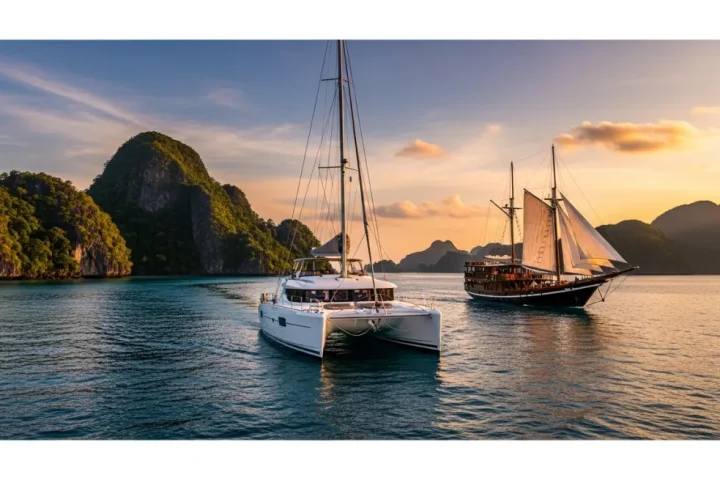
Tipping on a Raja Ampat sailing yacht is customary but never compulsory. The guidance most Indonesian liveaboards give guests is roughly USD 10–20 per guest per day, pooled and split across the whole crew — deck, galley, dive team and captain. On a seven-night trip that is around USD 70–140 per person. Cash in Sorong beforehand; there is no ATM at sea.
Tipping is the question guests are most embarrassed to ask and most anxious to get right. It should not be either. There is a straightforward local norm, it is not a hidden charge, and nobody on a well-run boat will treat you differently for landing at the lower end of a range.
How much should you tip on a Raja Ampat liveaboard?
| Trip length | Modest | Typical | Generous |
|---|---|---|---|
| 4 nights | USD 40 | USD 60 – 80 | USD 100+ |
| 6 – 7 nights | USD 60 – 70 | USD 100 – 140 | USD 175+ |
| 9 – 10 nights | USD 90 – 100 | USD 150 – 200 | USD 250+ |
| 11 – 12 nights | USD 110 – 120 | USD 180 – 240 | USD 300+ |
These are per guest, not per cabin, and they reflect the guidance commonly given across Indonesian liveaboards rather than a fixed rule. Boats occasionally publish their own suggested figure in the pre-trip pack — if yours does, follow it, because it is calibrated to that crew’s size and pay structure.
Two adjustments worth making. Scale up if the crew did something genuinely extra: reorganised the route for your dive goals, dealt with a medical issue calmly, ran extra night dives. Scale down without guilt if service was indifferent. A tip that is automatic regardless of performance is not really a tip.
How are tips split between the crew?
Almost always pooled. The standard practice on Indonesian vessels is a single crew fund divided by an internal formula the crew agrees among themselves, usually weighted by role and seniority. That means your dive guide, the engineer you never met, the cook who worked in a hot galley for a week and the deckhands who carried your tanks all receive a share.
This is why we discourage tipping individuals separately as your main approach. Singling out your dive guide feels natural — they are the person you spent the most time with — but it quietly removes money from a system the crew designed to be fair, and it puts the guide in an awkward position with colleagues.
The reasonable exception: a small additional personal tip on top of your pool contribution, for someone who genuinely went beyond their role. Hand it over discreetly, at the end, and make clear it is in addition to the pool.
Cash or transfer? Rupiah or dollars?
| Method | Works? | Notes |
|---|---|---|
| Rupiah cash | Best | No conversion loss for the crew, spendable immediately |
| USD cash | Widely accepted | Bring clean, unmarked, undamaged notes — Indonesian exchange counters reject worn USD |
| Euro or AUD cash | Accepted, less ideal | Harder to change in Sorong; expect the crew to lose a little on rate |
| Bank transfer | Sometimes | Some operators can forward tips to the crew fund; ask in advance, do not assume |
| Card | Rarely | Not available on most vessels |
Bring the cash from Sorong. This is the practical point that catches guests out every season: ATM access in Raja Ampat is unreliable and there is no cash machine at anchor. Draw what you need — tips, entry fees if your operator collects them locally, and money for village purchases — before you board. Our Sorong pre-departure guide covers the practicalities.
Small denominations help. A crew fund of USD 800 in twenty-dollar notes is easier to split than four two-hundreds.
When should you not tip extra?
Three situations:
- A service charge is already applied. Some vessels, particularly at the luxury end, add a service charge to the fare. Read the invoice. If one exists, a tip on top is optional generosity rather than expectation.
- All-inclusive private charter with a contracted crew gratuity. Whole-boat charter contracts sometimes bake in a crew payment. Ask at contract stage — this is exactly the sort of thing the private Phinisi charter paperwork should spell out.
- Service was genuinely poor. You are not obliged. But say something to the operator rather than only reducing the envelope, because a silent low tip teaches nobody anything.
What do crews value besides cash?
More than you would expect, and none of it replaces the tip:
- A named review. Mention the dive guide, the cruise director and the cook by name in an online review. This has real career value in a small industry where reputation travels.
- Photos sent back. Crews rarely have images of themselves working. Sending a folder of photos afterwards is genuinely appreciated — ask the cruise director for a contact address.
- Gear you were going to replace anyway. A serviceable mask, a dive computer you have upgraded from, a decent torch. Offer it to the cruise director rather than handing it to an individual.
- Feedback to the operator. Specific praise sent to the office reaches people whose promotions depend on it.
What crews do not need: leftover sunscreen, half-used toiletries, or a bag of things you did not want to carry home. There is a difference between a gift and offloading rubbish onto someone who cannot refuse it politely.
How and when is the tip handed over?
On the last evening or the final morning, usually in an envelope, given to the captain or cruise director for the pool. Many boats hold a short farewell gathering where guests hand over collectively — if you are travelling as a group, one person consolidating everything is simpler than eight separate envelopes.
Write a short note if you can. “Thank you — the whole crew” costs nothing and matters more than the exact amount inside. If you have specific praise for individuals, name them there; it will be read out.
Budget the tip at the same time you budget the government fees — around IDR 1,700,000 per foreign visitor for the marine park permit and regency ticket combined, as of July 2026 — so nothing arrives as a surprise on the last day. Our cabin types guide and the 7D6N package both list costs the same way: separately and in full.
Frequently asked questions
How much do you tip a liveaboard crew in Raja Ampat?
Commonly USD 10–20 per guest per day, pooled across the crew. On a seven-night trip that is roughly USD 70–140 per person. It is customary, not compulsory.
Is tipping compulsory on an Indonesian liveaboard?
No. It is an established custom and crews rely on it, but no reputable operator will pressure you, and service quality should not depend on it.
Should I tip the dive guide separately?
Contribute to the pool first. A small personal tip on top for someone who went beyond their role is fine, but bypassing the pool undermines a system the crew designed together.
Can I tip in US dollars in Raja Ampat?
Yes, widely. Bring clean, undamaged notes in small denominations — worn or marked USD is often refused by Indonesian exchange counters. Rupiah is ideal.
Do I need to bring tip money with me?
Yes. Draw cash in Sorong before boarding. There are no reliable ATMs once you are sailing and most vessels cannot process card payments for gratuities.
What if a service charge is already included?
Then an additional tip is optional. Check the invoice or the charter contract before you assume either way, particularly on private whole-boat charters.
Plan the whole cost, not just the fare
Ask us for a full cost sheet before you book and we will list the fare, the government fees and a realistic gratuity budget separately, so nothing lands unexpectedly on the last morning. Charters are operated by Komodo Luxury, an Indonesian charter company running crewed sailing trips since 2015. Dietary requests and other pre-trip details are covered in our onboard food guide.
WhatsApp: +62 811 3823 875 · Email: [email protected]