Sailing vs Yacht Charter Raja Ampat: A Definitive Comparison for the Discerning Traveler
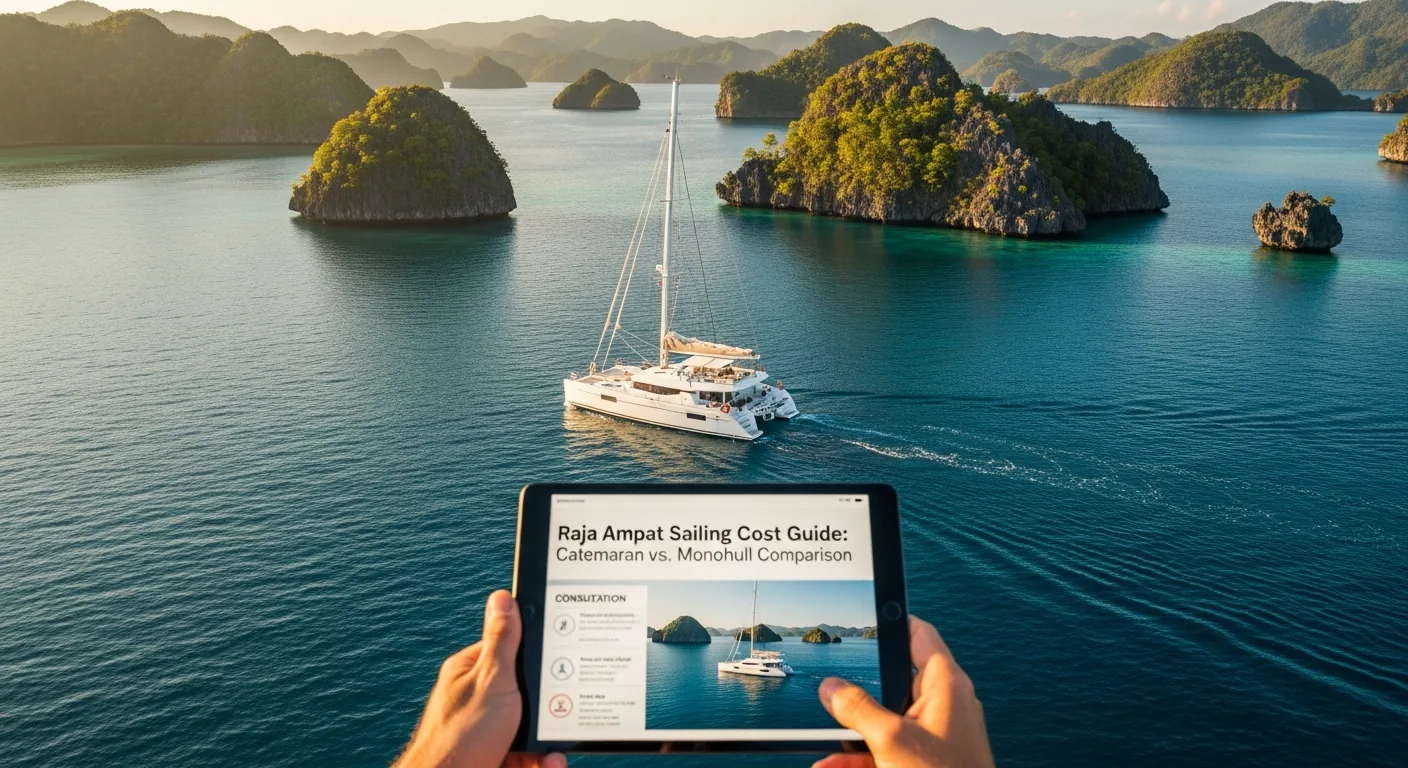
The pre-dawn air in the Dampier Strait is thick with the scent of salt and damp earth. Aboard the deck, the only sounds are the gentle lapping of water against the twin hulls and the distant call of a Papuan hornbill. As the first light fractures across the horizon, illuminating the jagged silhouettes of Kri and Mansuar islands, the fundamental question of any Raja Ampat expedition presents itself: not just where to go, but how. The method of travel across this aquamarine expanse defines the experience, shaping every hour and every interaction with one of the planet’s most biodiverse marine environments.
For the discerning traveler planning an expedition through this archipelago of over 1,500 islands, the choice often distills down to two distinct philosophies of sea travel: the elemental grace of a raja ampat sailing catamaran versus the expedient power of a motor yacht. This is not a simple matter of preference but a decision that dictates the pace, rhythm, and texture of your entire journey. It is the difference between harnessing the wind to glide into a secluded cove and powering across open water to maximize a packed itinerary. Here, we provide a detailed analysis to guide your choice, drawing on expert insight and logistical realities to distinguish between a sail and a charter in the world’s last true marine frontier.
Defining the Fleet: The Essential Differences in a Raja Ampat Sail
At its core, the distinction lies in propulsion and design philosophy. A vessel built for sailing and one powered by engines offer fundamentally different platforms for exploring Raja Ampat. Understanding these differences is the first step in aligning the vessel with your expectations. See also: Contact.
A modern raja ampat catamaran sail, such as a Lagoon 46 or a Fountaine Pajot Saona 47, is designed for stability and a close-to-the-water experience. Its twin-hull design minimizes roll, providing a comfortable platform both under way and at anchor. The shallow draft, often less than 1.5 meters, grants access to coves and bays off-limits to deeper-keeled vessels. “The real advantage of a catamaran here is intimacy with the environment,” notes Captain Leo Suparman, a mariner with over two decades of experience navigating the Coral Triangle. “You move with the elements, not against them. The quiet allows you to hear the splash of a surfacing dugong or the chatter of parrots on the shore. It’s a more sensory experience.” The reliance on wind, supplemented by engines for calm days or precise maneuvering, also means significantly lower fuel consumption—an important consideration for environmentally-conscious travel in this protected region.
Conversely, a motor yacht—whether a modern luxury cruiser or a traditional Indonesian Phinisi schooner refitted with powerful engines—is built for range and comfort. These vessels can cover the 120 nautical miles from the Dampier Strait to the Wayag archipelago in a fraction of the time a sailboat would require. Cabins are typically larger, common areas are fully air-conditioned, and amenities can extend to dedicated dive centers and jacuzzis. A Phinisi, while possessing masts and sails, operates primarily as a motor-sailer in these waters, using its sails for stability or downwind runs rather than as a primary mode of propulsion. Their purpose is to deliver guests to a series of iconic destinations—Wayag, Piaynemo, Misool—with speed and in a climate-controlled environment. See also: Raja Ampat Sailing.
The Itinerary Question: Pace, Place, and Possibility
Your choice of vessel directly shapes the geographic scope and tempo of your expedition. The distances in Raja Ampat are significant, and how you traverse them is a critical factor. A sailing raja ampat itinerary is, by nature, more focused and immersive. An 8-day/7-night sail might concentrate on the central region, exploring the intricate passages of the Fam Islands, the iconic viewpoint at Piaynemo, and the vibrant reefs around Arborek Island. The journey is dictated by wind patterns and a desire to minimize time under motor. This results in more time spent at each anchorage, allowing for multiple dives at a single site like Melissa’s Garden or leisurely paddles through mangrove forests.
A motor yacht charter, in the same timeframe, can offer a “greatest hits” tour. It’s feasible to depart Sorong, head north to the dramatic karst islands of Wayag, travel south to Piaynemo, and still have time for the world-renowned diving at Cape Kri, which holds the record for the highest number of fish species (374) identified on a single dive by Dr. Gerald R. Allen. The trade-off for this breadth is depth; transitions between locations are faster, and the experience is more destination-oriented than journey-focused. See also: book Catamaran Fleet.
Vessel Type & Itinerary Comparison
| Feature | Sailing Catamaran (e.g., Lagoon 46) | Motor Yacht (e.g., 30m Phinisi) |
|---|---|---|
| Typical 8-Day Itinerary | Focus on a single region (e.g., Central Raja Ampat: Dampier Strait, Fam Islands, Gam). | Can cover multiple regions (e.g., Central Raja Ampat and Northern Wayag). |
| Pace | Slower, more relaxed. Average speed 5-7 knots. Governed by wind and sea state. | Faster, more efficient. Average speed 8-10 knots. Less dependent on weather. |
| Access | Excellent access to shallow bays and secluded beaches due to low draft. | Limited by deeper draft; relies on tenders for shallow water exploration. |
| Experience Focus | The journey itself, connection to the sea, quiet anchorages. | Maximizing the number of iconic destinations visited. |
Onboard Experience: From Crew Interaction to Cabin Comfort
Life aboard a raja ampat sailboat is inherently more intimate. With a smaller guest capacity (typically 6-8 passengers) and a crew of 3-4, the dynamic is collaborative. Guests often develop a rapport with the captain and crew, sharing meals and discussing the day’s plans. The soundscape is natural—wind in the sails, water on the hull, the calls of birdlife. Evenings are often spent on the open-air trampolines or in the cockpit, directly under the stars. “The reduced noise pollution from a sailing vessel is not trivial,” explains marine biologist Dr. Anya Sharma. “At sites like Manta Sandy (0°30’35.0″S 130°40’50.0″E), the quiet approach of a catamaran is less likely to disturb the Oceanic Manta Rays during their cleaning rituals.”
A motor yacht offers a more structured and service-oriented environment. The larger crew includes specialized roles like a cruise director, dedicated dive masters, and hospitality staff. The separation between guest and crew areas is more pronounced. The constant hum of generators powers amenities like 24/7 air conditioning, ice makers, and sophisticated entertainment systems. For groups seeking a higher level of conventional luxury and service, with minimal exposure to the raw elements except when actively swimming or diving, a motor yacht provides a familiar five-star hotel-style experience transposed onto the sea. See also: Home.
The Cost Equation: A Detailed Breakdown of a Raja Ampat Charter
The financial structures for chartering a sailing catamaran versus a motor yacht are markedly different. Transparency in pricing is key to avoiding unforeseen expenses. A raja ampat sailing charter is often offered at an all-inclusive or semi-inclusive per-person rate.
- Sailing Catamaran: For a vessel like our Lagoon 46, “The Serenity,” a typical 7-day/6-night private charter might be priced from $4,500 USD per person (based on a group of 6). This rate generally includes the private vessel, captain and crew, all meals and non-alcoholic beverages, and use of snorkeling gear and kayaks.
- Exclusions: Common exclusions are Raja Ampat Marine Park permits (currently IDR 1,000,000, or approx. $70 USD per person), dive equipment rental or courses, alcoholic beverages, and crew gratuity.
Motor yachts, particularly the larger Phinisi, are almost always chartered on a “plus all expenses” basis. This involves a base charter fee for the vessel and crew, plus an Advanced Provisioning Allowance (APA).
- Motor Yacht: A 30-meter Phinisi accommodating 10 guests could have a weekly base charter fee ranging from $35,000 to $70,000 USD.
- Advanced Provisioning Allowance (APA): An APA, typically 25-30% of the charter fee (an additional $8,750 – $21,000+ USD in this example), is paid upfront. This fund covers all variable expenses, including fuel, food, beverages, port fees, and any special requests. The captain manages this account and provides a detailed breakdown at the end of the charter. Any unspent funds are returned to the charterer.
Cost Structure Comparison
| Cost Component | Sailing Catamaran | Motor Yacht (Phinisi) |
|---|---|---|
| Pricing Model | Often per-person, all-inclusive rate. | Base charter fee + APA (25-30%). |
| Estimated 7-Day Cost (6 guests) | Approx. $27,000 USD (plus specified exclusions). | $43,750 – $91,000+ USD (base fee + APA). |
| Budget Predictability | High. Costs are largely fixed upfront. | Lower. Final cost depends on consumption (especially fuel). |
| Included in Price | Vessel, crew, meals, non-alcoholic drinks, standard water toys. | Vessel and crew only (base fee). All other expenses covered by APA. |
Navigating the Elements: Wind, Weather, and When to Go
Raja Ampat’s prime exploration season runs from October through April, during the northwest monsoon, which brings calmer seas and clearer skies. This period is ideal for sailing, with consistent but manageable winds typically in the 5-15 knot range. A skilled captain can leverage these conditions for exhilarating passages between islands, minimizing engine use. The water temperature remains a consistent 28-30°C (82-86°F) year-round, making it a premier destination for diving and snorkeling regardless of vessel.
During the shoulder months and the southeast monsoon (May-September), seas can be choppier, particularly in the south (Misool). While a raja ampat catamaran sail is still very capable, a motor yacht’s power and weight provide a greater degree of schedule certainty, able to push through less favorable conditions to maintain an itinerary. For travelers with fixed dates and a low tolerance for weather-related plan changes, a motor yacht offers a distinct advantage in predictability.
Your Raja Ampat Expedition: Making the Right Choice
Ultimately, the ideal vessel is the one that aligns with your personal definition of exploration. There is no single “better” option, only the right fit for your group, your budget, and your aspirations. To make a decision, consider the following questions:
- What is my priority? Is it the meditative quality of the journey itself, feeling the wind and sea, or is it efficiently reaching a series of world-renowned natural wonders?
- What is our group’s dynamic? Are we an active, hands-on group that would enjoy the intimacy of a catamaran, or do we prefer a more formal service structure with extensive amenities?
- What is our true budget? Are we more comfortable with a predictable, largely all-inclusive price, or are we prepared for the variable expenses associated with an APA?
- How important is silence? Do we seek the quiet of a remote anchorage with only natural sounds, or is the background hum of a generator an acceptable trade-off for creature comforts?
The answers will point you toward your ideal platform. For those who believe the voyage is as important as the destination, who seek a more direct connection with the marine environment, and who appreciate the elegant efficiency of wind power, a sailing catamaran offers a deeply rewarding way to experience Raja Ampat. It is a choice for the true explorer, the modern adventurer who understands that the richest moments are often found in the quiet spaces between the headline attractions.
Plan Your Authentic Raja Ampat Sailing Charter
Choosing the right vessel is the most critical decision for your expedition. At Raja Ampat Sailing, we specialize in crafting bespoke sailing itineraries on our fleet of modern catamarans. We focus on authentic, immersive experiences that connect you with the heart of the archipelago. Our expert planners can discuss your specific interests, from marine biology to underwater photography, to design a journey that transcends a simple vacation.
Consult with our expedition team to begin designing your private raja ampat sail.
Brand: Raja Ampat Sailing
Phone: 0811-3941-4563
Email: bd@juaraholding.com
Office: Jalan Sunset Road No. 88, Kuta, Badung, Bali 80361